On this page
Gemini 4 Argon became broadly available on October 13. A day later I gave it and Claude Opus 5.5 the same detailed prompt: build a polished one-tap flying game I can play in my phone’s browser. One message, no follow-ups, no fixes.
Short answer: Claude was faster, Gemini was cheaper, and both games worked. The bigger lesson came from a third run. I gave the same prompt to Opus 5.5 inside Google’s Antigravity, and it took more than five minutes longer than in Claude Code.
Play the games
All three games are live. Tap one on your phone and judge for yourself.
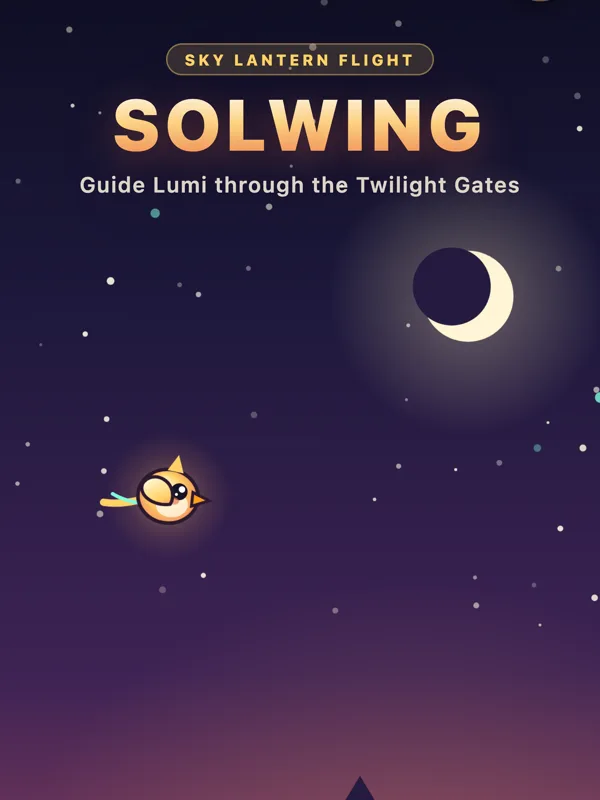 SOLWINGGemini 4 · Antigravity▶ Play
 SkybunClaude Opus 5.5 · Claude Code▶ Play
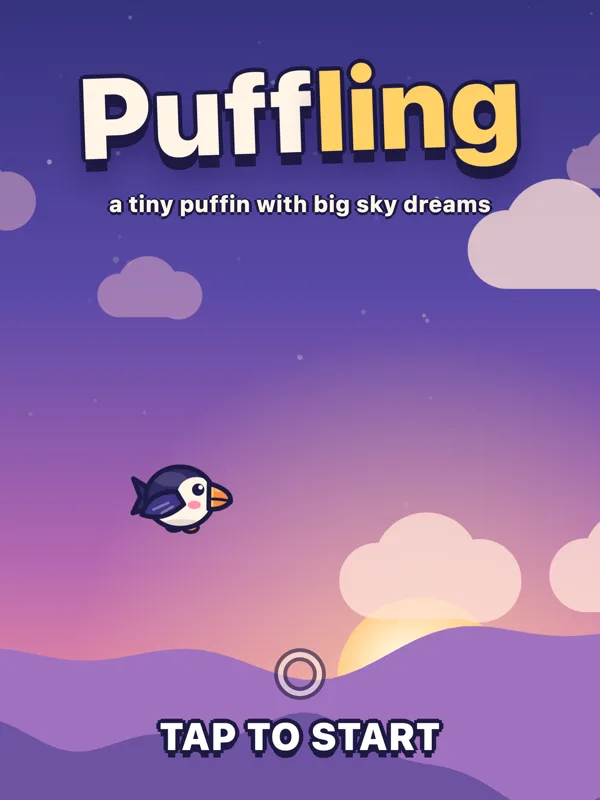 PufflingClaude Opus 5.5 · Antigravity▶ Play
Each one is exactly the file the model wrote, plus one line in the page head that points search engines to this post.
The results
| Gemini 4 Argon | Claude Opus 5.5 | Claude Opus 5.5 | |
|---|---|---|---|
| Tool | Antigravity CLI | Claude Code | Antigravity CLI |
| Game | SOLWING | Skybun | Puffling |
| Build time | 9:16 | 8:59 | 14:28 |
| Cost | ≈ $0.73 (≈ $1.45 from Dec 1) | $1.67 | ≈ $2.6 |
| File | 64.5 KB, 1,938 lines | 39.8 KB, 1,167 lines | 46.1 KB, 1,255 lines |
| Tested its own game | Headless Chrome check, 3 screenshots | Headless Chrome, autopilot scored 12, fixed 2 visual bugs | 23 automated checks, autopilot scored 15, fixed 3 bugs |
| Worked first try | Yes | Yes | Yes |
| Extra, not asked for | Rank titles on game over | Pauses when you switch apps; a “tap to flap” ready screen | Pause key, pauses on app switch, a landing sound |
The Claude Code cost is what Claude Code reported. The other two are my estimates from token counts at published API prices, because Antigravity runs on my subscription and produced no bill.
Round 1: speed
Claude Opus 5.5 in Claude Code finished in 8:59. Gemini 4 Argon in Antigravity finished in 9:16. That’s a 17-second gap on a nine-minute job, close enough to call it a tie in practice.
Round 2: price
Gemini used 86k input tokens, 38.8k output tokens and 9.3k thinking tokens. At the intro price ($2 in, $10 out per million) that’s about $0.73, less than half of Claude’s $1.67.
The intro price ends on November 30. From December 1 Argon costs $4 in and $20 out, the same list price as Opus 5.5, and the same run would cost about $1.45. So the gap is real today and mostly gone in about seven weeks.
Round 3: does it play?
All three games worked on the first try. Every requirement in the prompt was in all three files: one file, Web Audio sounds, a saved best score, vibration, screen shake, particles, parallax, safe areas, sharp rendering on high-DPI screens, and no zooming.
The part I liked most: each model play-tested its own game before handing it over. Gemini wrote a headless Chrome check and took three screenshots. Claude in Claude Code ran an autopilot that scored 12 and then fixed two visual bugs it found. Nobody asked for an autopilot. The prompt only said “check that the game actually works and fix anything that’s broken.”
Each one also added something I didn’t ask for. Gemini gives you a rank title on the game over screen, from “Ember Glider” up to “Astral Sovereign.” Claude pauses the game when you switch apps and adds a “tap to flap” ready screen before the run starts.
The twist: same model, different tool
Antigravity can also run Claude. So I ran the same prompt with Opus 5.5 inside Antigravity, started at the same moment as Gemini on the same Mac.
It took 14:28. It also did more: 23 automated checks, an autopilot that scored 15, and three bug fixes. It used 80.9k output tokens and 2.33M cached reads, about $2.6 at API prices.
Same model, same effort level, same prompt. Over five minutes slower and roughly $1 more. The tool around the model decides how it plans, what it checks and how much context it drags along. Antigravity’s docs also say background Gemini models handle context management even when you pick Claude, so “Claude in Antigravity” isn’t “Claude in Claude Code.”
The prompt
This is the full prompt, word for word. Copy it and try your own model.
Build a polished mobile game I can play in my phone's browser.

Concept: a one-tap flying game in the spirit of Flappy Bird, with its own original
character, art and name. Tap to flap, gravity pulls you down, fly through the gaps
between obstacles. Every gap you pass is +1 point. Hit anything and it's game over.

Requirements:
- One file: index.html with all HTML, CSS and JavaScript inline. No external
  libraries, images, fonts or audio files. Draw everything in code and make
  sounds with the Web Audio API.
- Built for phones in portrait. Fill the screen, respect safe areas, stay crisp on
  high-DPI screens. Tap anywhere to flap; also support mouse click and the space bar
  for desktop testing. No scrolling, zooming or text selection while playing.
- Screens: a start screen with the game's name and a "tap to start" hint, the game,
  and a game over screen with the score, the best score (saved in localStorage) and
  a restart button.
- Game feel: smooth motion that doesn't depend on frame rate, a character that tilts
  with its speed, a flap animation, parallax background layers, particles on flap
  and crash, a small screen shake on crash, and a short vibration on crash where the
  browser supports it.
- Difficulty: start forgiving, then slowly narrow the gaps and speed up as the score
  grows.
- Sound: flap, point and crash sounds, plus a mute toggle. Start audio only after the
  first tap.
- Polish: one consistent art style and color palette, a readable score at the top,
  nothing under the notch or the home bar.

When you're done, check that the game actually works and fix anything that's broken.
Then tell me in a few lines what you built and how to run it.
How I ran the test
- Same prompt, one shot. Each model got the text above once, in a fresh empty folder. No follow-up messages, no fixes.
- Models and tools. Gemini 4 Argon (
gemini-4-argon-high) in the Antigravity CLI 1.3.4. Claude Opus 5.5 at high effort in Claude Code 2.1.285. Claude Opus 5.5 (claude-opus-5-5-high) in the Antigravity CLI. - Timing. Gemini and Opus in Antigravity started at the same moment on the same Mac. Opus in Claude Code started seven minutes later.
- Cost. Claude Code reported its own cost. For the Antigravity runs I multiplied token counts by published API prices: Argon $2 in, $10 out, $0.10 cached per million tokens (from December 1: $4, $20, $0.20), and Opus 5.5 $4 in, $20 out, $0.20 cache read.
- Gameplay footage. For the video, an autopilot script played every game the same way in the iOS Simulator (iPhone 17 Pro, Safari). It read game state through a read-only hook in a separate copy of each file. The games you can play above don’t have that hook.
- Background models. According to Antigravity’s docs, it uses Gemini models for background context management even when a Claude model is selected.
One run per model, one prompt. This is a fun test, not a benchmark. The benchmarks themselves are split: Opus 5.5 leads Terminal-Bench 4.0 on every board, Gemini 4 Argon is #1 on the Vals Index, and on Artificial Analysis at High effort it’s 54 vs 53.
What app builders should take from this
- Test the model inside the tool you’ll actually ship with. The same Opus 5.5 took 8:59 in Claude Code and 14:28 in Antigravity. If you compare models in a playground and then build in a different agent, your numbers won’t hold.
- Write the prompt like a spec, and end it with “check that it works.” Every requirement I listed showed up in all three games, because each one was concrete: safe areas, localStorage, frame-rate-independent motion. The last line made every model test its own work, and two of them found and fixed bugs before I saw anything.
- Budget on the price after the promo, per job, not per token. Gemini’s run was about $0.73 today and about $1.45 from December 1, close to Claude’s $1.67. Opus in Antigravity used far more tokens and landed near $2.6. Check what a real task costs in your setup before you commit.
Watch the 58-second version
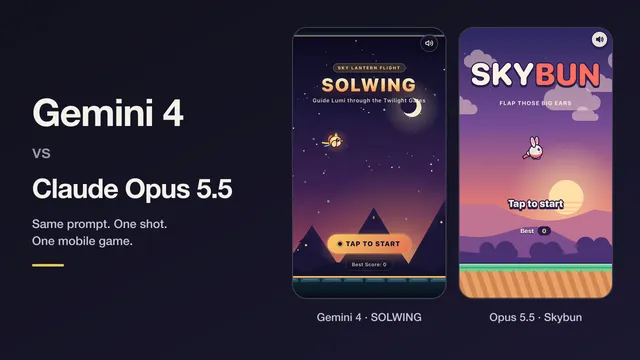
The Short below shows both games side by side, round by round, with the scoreboard.
Frequently asked questions
Is Gemini 4 better than Claude Opus 5.5 for coding?
Not clearly. In my test both built a working game on the first try. Independent boards are split: Opus 5.5 leads Terminal-Bench 4.0 on every board, while Gemini 4 Argon is #1 on the Vals Index. At High effort on Artificial Analysis it's 54 for Opus vs 53 for Argon.
Is Gemini 4 cheaper than Claude Opus 5.5?
Until November 30, yes: Gemini 4 Argon costs $2 in and $10 out per million tokens, Opus 5.5 costs $4 and $20. From December 1 Argon moves to $4 and $20, the same list price. Token use matters too: in my run Gemini's job came to about $0.73 vs $1.67 for Claude.
Can I use Claude Opus 5.5 inside Google Antigravity?
Yes. Antigravity offers Opus 5.5 and Sonnet 5.5 next to Gemini. Its docs say Gemini models still handle background context management when you pick Claude. In my run Opus 5.5 took 14:28 there, vs 8:59 in Claude Code.
Can I play the games?
Yes. SOLWING, Skybun and Puffling are linked in the post. They are the files each model wrote, with one line added to the page head that points search engines to this post.
Sources
- Google — Gemini 4 Argon, built to solve your hardest problems
- VentureBeat — Argon broadly available at $2/$10
- Anthropic — Introducing Claude Opus 5.5
- Claude docs — Models overview
- Google Antigravity docs — model table and background models
- Artificial Analysis — Gemini 4 Argon (High) vs Claude Opus 5.5 (High)
- Vals AI — Gemini 4 Argon
- OrcaRouter — Argon vs Opus 5.5, two boards, two verdicts